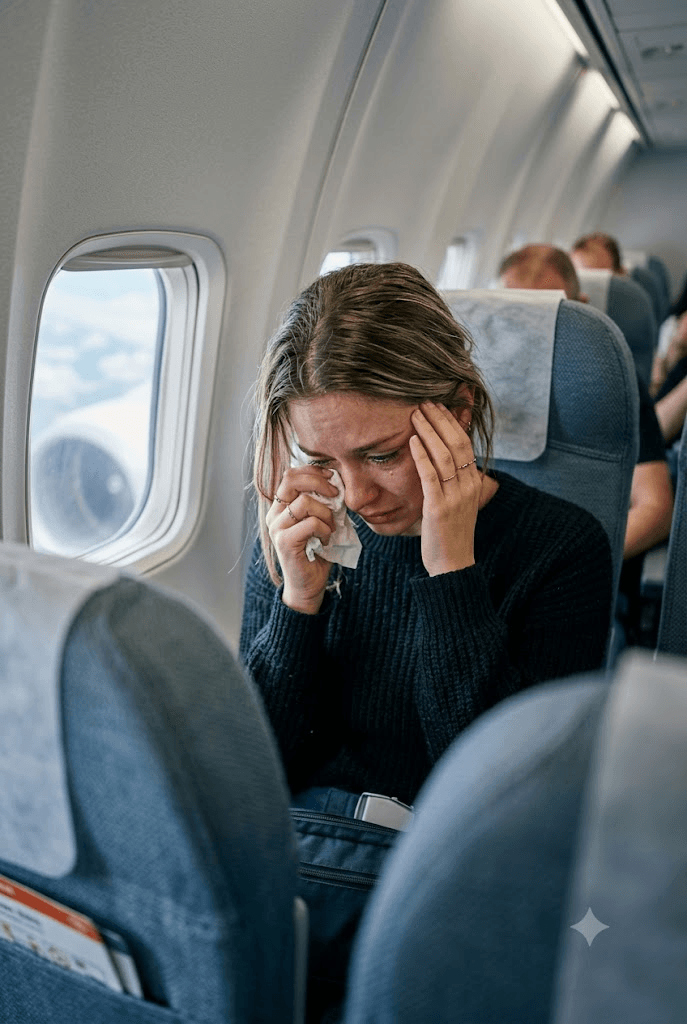
The night before I leave, I do this thing where I fold his laundry that does not need folding. I over-buy groceries. I write little notes about the bins and the plants. And underneath all of it hums the same low, familiar ache: the guilt when I leave my partner to get on a plane, whether it is for a work conference in another city or a week away in the sun with my girlfriends. I am a woman in my early thirties trying to hold a career, a relationship, and a passport all in the same two hands, and every single time I go, I feel like I am doing something wrong.
If you have ever sat at a departure gate feeling more like a fugitive than a traveller, this one is for you. Because the guilt when I leave my partner is not a character flaw, and it is not proof that I love him too much or too little. It is a predictable emotional response with roots in psychology, attachment, and the quiet stories women are taught about who deserves rest. Let us pull it apart.
What Guilt Actually Is (And Why It Shows Up at the Airport)
Guilt is what psychologists call a self-conscious emotion. Unlike fear or anger, which fire off almost instantly, guilt requires you to step outside yourself, imagine your impact on someone else, and judge yourself against a standard. It is the emotion of the empathetic and the conscientious. So the first reframe is a gentle one: the guilt when I leave my partner is partly evidence that I am wired to care about the person I am leaving behind.
The trouble is that guilt is designed to flag genuine wrongdoing, moments when we have actually broken a bond or hurt someone. Booking a holiday or accepting a work trip is not wrongdoing. Yet the same alarm system rings, because on a primal level, leaving the person we are attached to registers as a small rupture. Your nervous system does not neatly separate “I abandoned him” from “I am spending five days in Portugal.” It simply notices the distance and sounds a soft warning.
Why the Guilt When I Leave My Partner Is Really About Attachment
Attachment theory gives us the clearest map here. The bonds we form with romantic partners echo the bonds we formed as children with caregivers, and separation, even brief and happy separation, activates the attachment system. Research on couples has found that attachment anxiety is closely tied to how we regulate and express emotion when we are apart from a partner, shaping everything from how much we reassure to how much we quietly panic (Brandão et al., 2019).
If you lean even slightly toward anxious attachment, leaving can feel disproportionately threatening. You are not just going away; some part of you fears the connection will fray while you are gone. Studies on how anxious individuals respond to relationship threat show they are especially attuned to guilt and to any sign that the bond is at risk (Overall & colleagues, APA). This is why the guilt when I leave my partner can feel so physical: if I feel bad enough about going, maybe it proves I still care, maybe it keeps us safe.
There is another layer, too. Sometimes the guilt shows up because we are quietly excited to go. Feeling relief or joy about time away can trigger a second wave of shame, as if wanting space means something is wrong with the relationship. It does not. As one long-running advice column put it, being able to enjoy life without your partner nearby is often “a sign of maturity” rather than a betrayal (The Guardian).
The Gendered Weight Women Carry
I would be dishonest if I pretended this was purely individual psychology. Women are handed a specific script: we are the keepers of the emotional temperature, the ones who remember birthdays, notice when the fridge is empty, and sense when someone is off. When I leave, I am not just leaving a person, I am stepping away from a role I have been taught is mine to hold. That is why the guilt often arrives dressed as logistics, the endless mental list of what will fall apart without me.
This invisible caretaking has a name, and understanding it changed how I read my own guilt. If you have never examined how much of the relationship’s emotional admin lands on you, it is worth sitting with the idea of the emotional labour imbalance that so many women quietly manage. Once you see it, the guilt when I leave my partner starts to look less like love and more like conditioning.
Why It Hits Again When I Come Back
Here is the part that surprised me most. The guilt does not end when I land back home; sometimes it intensifies. Psychologists who study reunions point out that coming home reactivates all the unspoken fears of separation, and couples often fight or feel oddly distant right after a trip, not despite the reunion but because of it (Psychology Today). The person who stayed may feel they held everything together; the person who left may feel they need to over-apologise for the joy they had.
So I return and immediately start compensating. I cook the elaborate dinner. I downplay how wonderful the trip was. I slip straight back into over-functioning to erase the perceived debt of having been away. In this way, the guilt when I leave my partner has a twin: the guilt of re-entry, the discomfort of reconciling the freer version of me who existed on holiday with the caretaking version who lives at home.
How I Am Learning to Leave Without the Guilt
Naming the guilt as attachment plus conditioning, rather than moral failure, was the first real shift. Now, instead of trying to earn my trip through pre-departure over-preparing, I try to name what is happening out loud: “I am feeling the guilt when I leave my partner, and I know that is normal, not a sign I should stay.” Speaking it drains a surprising amount of its power.
The deeper work has been on boundaries and self-worth. I had to accept that rest and adventure are not rewards I must pre-pay for. Learning to set healthy boundaries without feeling guilty meant recognising that my partner is a capable adult who can manage a week without me, and that his temporary discomfort is not my emergency to solve. If you are a chronic over-giver, unlearning the reflex to stop being a people pleaser in your relationship is genuinely part of this too.
I also had to make peace with the science of why I need to go at all. Time away is not indulgence; it genuinely restores the nervous system, and there is real evidence for why holidays are a must for a reset. When I frame a trip as maintenance rather than escape, the guilt loosens its grip. I am not leaving to get away from my partner; I am leaving so I can return as someone with more to give.
The Reframe That Finally Stuck
The guilt when I leave my partner will probably never vanish entirely, and honestly, I have stopped wanting it to. A small flicker of it means I am attached, present, and human. What I have released is the belief that the guilt is an instruction, that it is telling me to stay, shrink, or apologise for wanting a life beyond the front door.
Love that requires me to feel bad every time I pursue joy is not love; it is a cage I have been decorating. So I still fold the laundry that does not need folding, but now I do it with a bit of tenderness rather than penance. Then I zip up my case, kiss him goodbye, and let myself go, guilt and all, trusting that the bond is strong enough to survive a little distance. Because it always is.
Love Gracie xoxo

Gracie Webb is a writer and researcher with a first-class degree in Psychology and over seven years of experience studying behavioural change, self-development, and the science of decision-making. She worked for four years as a research assistant in a cognitive behavioural therapy clinical setting, where she observed first-hand the gap between what people know they should do and what they actually do — a gap that sits at the centre of nearly all her writing. Gracie’s personal journey through a toxic long-term relationship, the slow process of rebuilding her self-worth, and the year she spent in therapy gave her both the intellectual framework and the personal authority to write about growth with honesty. Her work is rigorous, compassionate, and consistently aimed at the reader who is genuinely trying to change.