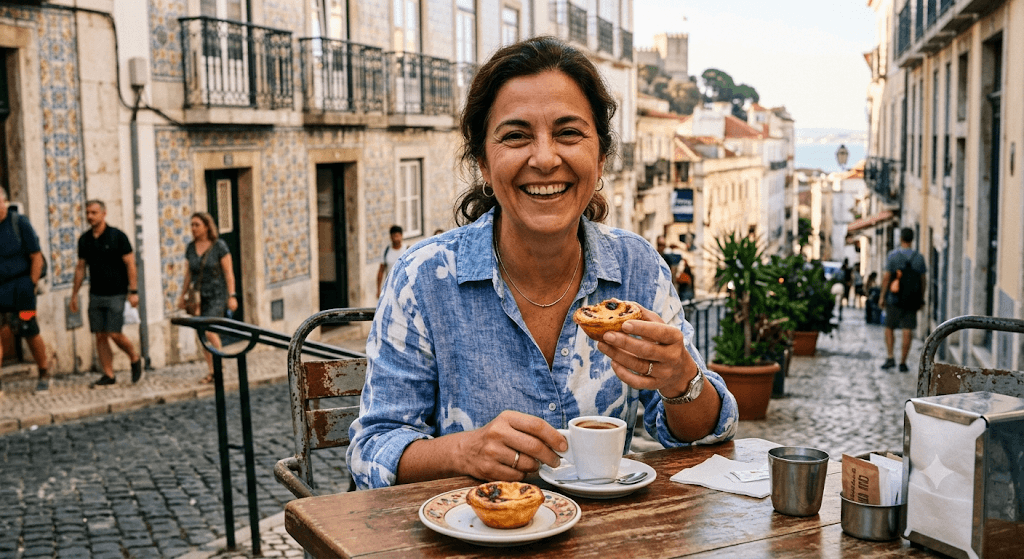
A holiday reset is exactly what my soul has been quietly begging for. Hello beautiful people. By the time you read this, I will be somewhere in Portugal, wandering cobbled streets with a coffee in one hand and a warm pastel de nata in the other, fully intending to gain a few happy kilos. I am off to visit family for a few weeks, and there is something almost magical about stepping out of your normal life — the one where you rush between cafes, restaurants and cheesy shows just to feel human — and into a slower, sunnier rhythm. My deep belief is simple: a holiday soothes the soul. And it turns out the science agrees with me.
Now, I am not saying Portugal is a must (although the coffee and tarts make a very convincing argument). A trip to a nearby regional town, a weekend by the coast, or even house-sitting a friend’s place while they are away can offer the very same holiday reset. What matters is the break itself — the deliberate act of stepping away. So before I switch my phone to airplane mode, here is my take, with a little research, on why a proper holiday a couple of times a year is not a luxury. It is a genuine necessity.
Why a Holiday Reset Matters for Your Nervous System
Most of us walk around in a low, humming state of stress that we have simply learned to call “normal”. Deadlines, group chats, school runs, that endless mental to-do list — our bodies treat all of it as a series of small alarms, and cortisol quietly keeps the pressure on. The problem is that our nervous systems were designed to handle bursts of stress followed by genuine recovery, not a decade-long marathon with no finish line. That is exactly why stepping away matters so much, and why learning to protect your energy is one of the most important skills you can build. If burnout has been creeping up on you, my anti-burnout guide is a gentle place to start.
A holiday interrupts that cycle in a way a single evening off simply cannot. Research published through the US National Institutes of Health found that even one short vacation produced large, positive and immediate effects on perceived stress, recovery and overall well-being. In other words, you do not need a month in the Maldives to feel the shift. You just need to actually stop.
What Actually Happens to Your Brain When You Rest
When you finally slow down, something quietly beautiful happens inside you. Cortisol levels begin to drop, your sleep deepens, and the part of your brain responsible for creativity and problem-solving comes back online. Suddenly you are having ideas in the shower again. You are laughing more easily. You are present at the dinner table instead of half-listening while mentally answering emails. I have written before about what happens to your mind and body when you finally slow down, and travelling is one of the most powerful ways to force that slowing to happen.
Psychologists have a lovely framework for this called Attention Restoration Theory. A study of Australian university staff, published via ScienceDirect, explored how short breaks and holidays restore our depleted attention — the same mental muscle we exhaust every single working week. New environments, whether that is a foreign city or a quiet cabin an hour from home, give our overworked minds the soft fascination they crave: rolling hills, unfamiliar streets, the sound of a different language drifting past a cafe. It is rest that feels effortless, and that is precisely why a holiday reset works.
Rest Is Not Selfish — It Is Maintenance
So many of us, especially women, carry a low-grade guilt about resting. We feel we should be earning it, or that stepping away means we are letting someone down. I want to gently push back on that. Rest is not a reward for finishing everything; it is the very thing that allows you to keep going at all. This is a theme close to my heart, which is why I keep returning to the idea that self-care isn’t selfish — it is honestly the most generous thing you can offer the people who depend on you.
The reporting backs this up. According to Psychology Today, reviews of the research consistently show that vacations have measurable positive effects on health and well-being. The catch — and this is important — is that the glow tends to fade a few weeks after you return to work. That single finding is the whole argument for why one big annual trip is not enough. We need these resets more regularly, sprinkled through the year like little pressure valves, rather than saved up for one heroic fortnight in summer.
The Real Health Case for Booking Your Holiday Reset
If you need one more nudge, consider the physical side. Time away has been linked to reduced cortisol, improved mood, better sleep and even long-term heart health. The Cleveland Clinic notes that the benefits of taking a holiday include lowering stress hormones, releasing mood-boosting chemicals and giving your brain the recovery it genuinely needs to function well. Your body keeps the score of every unbroken month you push through — and it also keeps the score of the moments you let yourself exhale.
You do not have to fly across the world to claim these benefits, either. A holiday reset is really about intention. It could be a spa day, a slow weekend with no plans, or simply booking yourself a treatment that reminds your body what calm feels like — I have made the full case for that in my piece on why an investment in massage is a high-yield strategy. The principle is identical whether you are in Lisbon or in your own living room: you are deliberately signalling to your nervous system that it is safe to stand down.
Give Yourself Permission to Reset
So here is my invitation to you as I pack my bag and prepare to disappear into a haze of coffee, custard tarts and family chaos. Do not wait until you are running on empty to give yourself a break. Do not treat the holiday as the thing you will get to once everything else is handled, because everything else is never handled. Book the regional getaway. Say yes to house-sitting for your friend. Take the long weekend you keep talking yourself out of.
A holiday reset, in whatever form your life and budget allow, is not an indulgence you have to justify. It is maintenance for a soul that has been carrying a great deal. The research is clear, my lived experience is clearer still, and Portugal is calling. Whatever your version of Portugal looks like, I hope you answer it too. Your soul, and quite possibly your cortisol levels, will thank you for it. Boa viagem, beautiful people — go and soothe your soul.
Love Arlyn xoxo

Rubie Le’Faine is the founder of Rubie Rubie and a writer specialising in emotional well-being, self-identity, and the psychology of modern relationships. She holds a Level 3 Certificate in Counselling Skills and has spent over eight years studying attachment theory, cognitive behavioural principles, and human development — first through formal study, then through lived experience that no course can replicate. After navigating a significant relationship breakdown, an identity rebuild, and the complex terrain of rediscovering herself in her 30s, Rubie began writing to make sense of what she had learned and to offer honest, human guidance to others going through the same. She founded Rubie Rubie in 2022 as a space for women seeking real answers, not platitudes. Based in Surrey, UK, her writing is grounded in research, shaped by experience, and centred entirely on the reader’s genuine wellbeing.