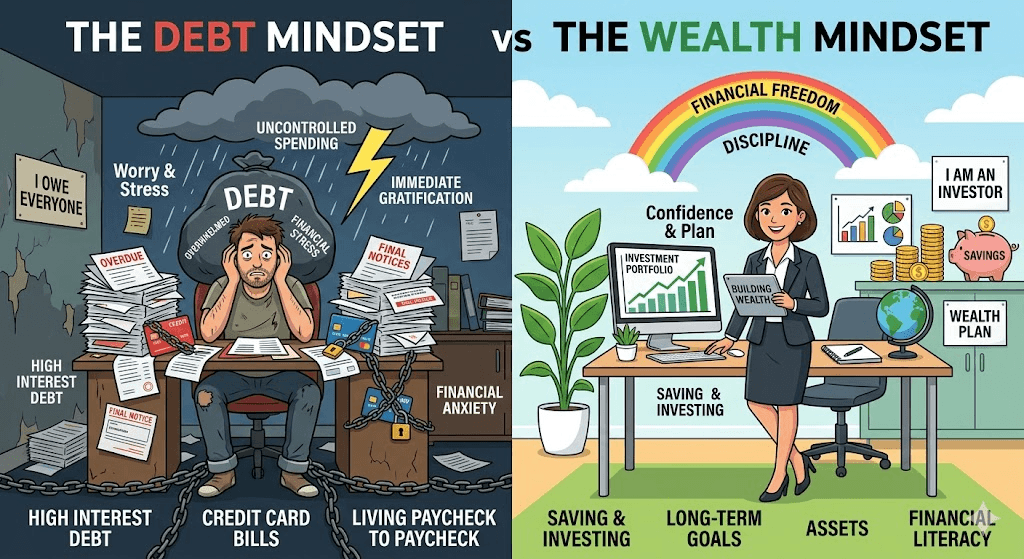
The debt mindset vs wealth mindset debate is at the heart of why some people build financial freedom while others stay stuck in a cycle of financial stress. Your relationship with money starts long before you earn it. It’s shaped by what you watched your parents do, by what was said (and unsaid) about money in your household, by early experiences of scarcity or abundance, and by the cultural narratives you absorbed about what wealthy people are like and what poor people deserve. These early imprints form what psychologists call a “money script” — a set of deeply held beliefs that govern how you save, spend, borrow, and think about financial security. Understanding the difference between a debt mindset and a wealth mindset isn’t just about budgeting — it’s about identifying the foundational beliefs that are shaping your financial life, often without your awareness.
Debt Mindset vs Wealth Mindset: What Each One Looks Like
A debt mindset isn’t simply having debt — it’s a way of relating to money that makes debt feel inevitable, normal, and inescapable. People with a debt mindset often believe, at some level, that financial struggle is simply what life is — that wealth is for other people, that they’ll always be playing catch-up, and that any money that comes in will inevitably go out before it can be saved or built upon.
This manifests in specific patterns. Spending money the moment it arrives rather than allowing it to accumulate. Using credit to fund lifestyle rather than investment. Avoiding looking at bank statements because the reality is too anxiety-producing. Making financial decisions based on what’s affordable right now rather than what moves you toward a goal. Normalising “everyone is broke” as a social reality that can’t be changed.
Research by Dr Brad Klontz, a financial psychologist at Creighton University and author of Mind Over Money, identifies “money avoidance” and “money worship” scripts as particularly associated with poor financial outcomes — the former involving the belief that money is bad or undeserved, the latter involving the belief that more money will solve all problems and that one can never have enough.
What Is a Wealth Mindset?
A wealth mindset isn’t about being rich — it’s about believing that your financial situation is something you have genuine agency over, and making consistent decisions that reflect that belief. People with a wealth mindset understand that small decisions compound over time, that financial education is an ongoing practice rather than a one-time event, and that the gap between their current situation and where they want to be is closable through sustained intentional action.
Crucially, a wealth mindset involves being able to think long-term rather than only short-term — to make a slightly less comfortable decision today in service of a significantly better position in five years. This capacity for delayed gratification, which psychologist Walter Mischel’s famous “marshmallow studies” at Stanford found to be strongly predictive of long-term outcomes, is less about willpower than about having a future self you care about and can vividly imagine benefiting from today’s choices.
Key Differences Between the Two Mindsets
On Spending
Debt mindset: Money is for spending. “You can’t take it with you.” Purchases are emotionally driven and often unplanned. Spending produces relief or pleasure that overrides longer-term consideration.
Wealth mindset: Spending is a tool, not a goal. Each purchase is evaluated against priorities. Emotional spending is noticed and managed rather than defaulted to.
On Saving
Debt mindset: Saving feels impossible — there’s never enough left over. Emergencies consume any surplus before it can accumulate. The idea of a meaningful emergency fund feels theoretical rather than achievable.
Wealth mindset: Saving is a non-negotiable that comes before discretionary spending, however small the amount. Even £50 or $50 per month, saved consistently, builds both a financial buffer and the habit and identity of being someone who saves.
On Debt
Debt mindset: Debt is a fact of life, managed month to month. The goal is to keep the minimum payments manageable. Interest costs are not closely examined.
Wealth mindset: Debt is a tool that carries a cost. It’s used strategically (for assets that appreciate or generate income) and reduced aggressively when it’s consumer debt at high interest rates. The total cost of debt over time, not just the monthly payment, is the number that matters.
On Financial Education
Debt mindset: Financial complexity is overwhelming and for people who are already wealthy. “I’m not good with money.” Avoiding financial information because it produces anxiety.
Wealth mindset: Financial literacy is learnable and worth investing in. Understanding compound interest, tax efficiency, investment basics, and debt structures is part of being a functional adult, not an elite skill.
How to Shift From a Debt Mindset to a Wealth Mindset
The shift isn’t primarily about income — research consistently shows that income alone doesn’t determine financial outcome. Lottery winners frequently return to their pre-win financial situation within a few years. High earners with debt mindsets often spend everything they make regardless of how much that is. The shift is about beliefs and habits, not numbers.
Start with small, consistent actions that build the identity of someone who manages money well: track spending for one month; create one savings transfer, however small, that goes out automatically; pay off one debt while making minimum payments on others; learn one new financial concept per month. None of these are dramatic. All of them, sustained, compound into meaningful change.
For more on how the choices you make at the foundational level — including financial choices — shape the trajectory of your life, this piece on choosing financial independence offers a practical and motivating perspective. And if debt anxiety is affecting your mental health, recognising when stress has reached unsustainable levels is an important first step in addressing both the emotional and practical dimensions of the situation.
Frequently Asked Questions
Can you have a wealth mindset with a low income?
Yes — though low income genuinely constrains options, and it’s important not to pretend that mindset alone overcomes structural poverty. The wealth mindset principles that are most income-independent are the behavioural ones: spending intentionally rather than reflexively, avoiding high-interest consumer debt where possible, saving even tiny amounts consistently, and continuing to develop financial literacy. These don’t require high income. They do require some financial stability — genuine poverty, where every penny is spoken for by basic survival, leaves little room for the kind of choices that shift the mindset. Acknowledging that structural reality is part of an honest conversation about financial wellbeing.
Is wanting money materialistic or shallow?
Money is a tool. Wanting enough of it to be secure, to have options, to support the people you care about, and to fund the life you want is not materialistic — it’s sensible. Research consistently shows that financial stress is one of the strongest predictors of poor mental health, relationship breakdown, and reduced wellbeing. Having enough money to not worry about money is a legitimate and important goal. The distinction is between money as a means (to security, freedom, generosity) and money as an end in itself — the latter is where research does identify a wellbeing plateau and diminishing returns.
How do I change beliefs about money that I’ve held for decades?
Slowly, and primarily through action rather than thought. Belief change follows behaviour change more reliably than the reverse — acting as if you have a wealth mindset, even when you don’t feel it yet, gradually builds the neural pathways and self-concept that the mindset requires. Financial therapy — a growing field that combines financial planning with psychological work on money scripts — is increasingly available and has strong evidence for people whose money beliefs are deeply entrenched and causing significant problems. Books like Your Money or Your Life (Vicki Robin) and The Psychology of Money (Morgan Housel) are excellent starting points for the intellectual dimension of the shift.

Jack Rylie is a writer and mental health advocate who has spent the past decade exploring resilience, identity, and emotional rebuilding — both as a writer and as someone who has navigated significant personal upheaval. After a career change in his early 30s that coincided with the end of a long-term relationship, Jack spent two years in psychotherapy and became deeply interested in how men process loss, change, and vulnerability in a culture that rarely creates space for it. He holds a Post-Graduate Certificate in Psychology of Mental Health and has contributed to mental health awareness campaigns with several UK-based organisations. His writing draws on clinical research, personal experience, and a long-held belief that honest male vulnerability is not a weakness — it is the foundation of genuine resilience.