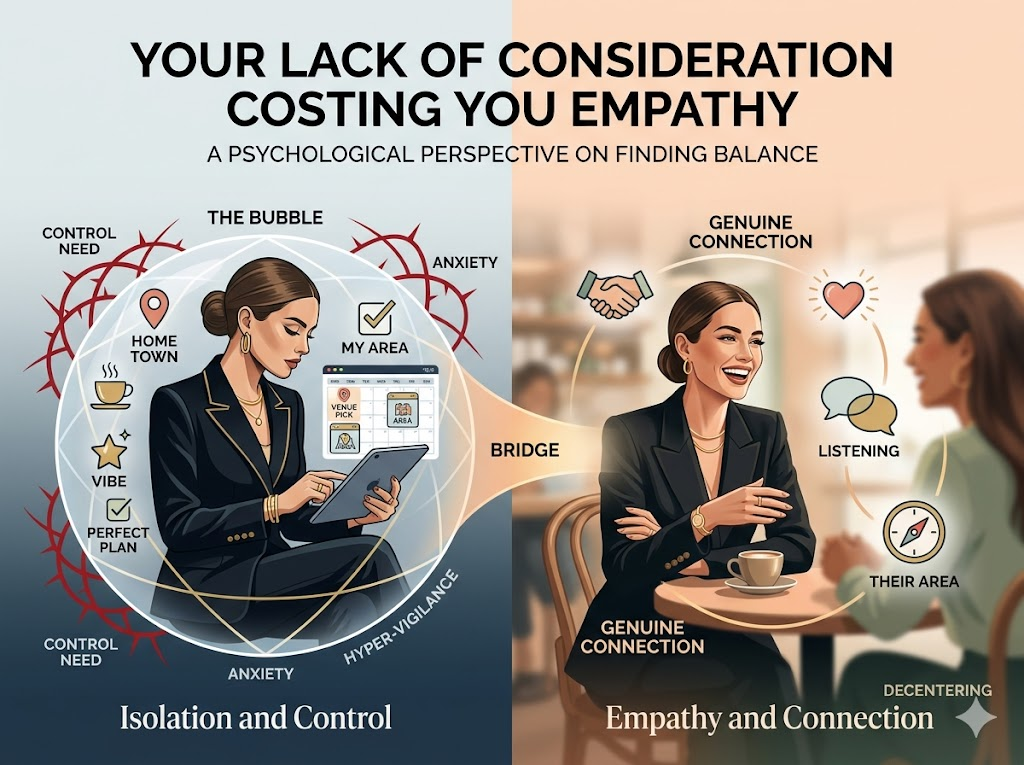
Welcome to a deeper conversation about the architecture of our social lives aka Psychology of Social Control. We often spend years meticulously building our “bubble”—perfecting our aesthetic, curating our inner circle, and anchoring ourselves in an environment that feels like home. But what happens when the very structures that give us comfort start to isolate us? Today, we are exploring a vulnerable shift: the moment self-care turns into self-centeredness, and how reclaiming our empathy can actually be the cure for our social anxiety. If you’ve found yourself holding the reins of your social life a little too tightly, let’s look at the psychological cost of control.
1. The Comfort of the “Bubble”: Why We Cling to Our Space
There is something deeply grounding about your own area. It’s your sanctuary. When we speak about loving our “bubble”—our neighborhood, our curated fashion, and our specific taste—we are discussing identity signaling. In psychology, our environment is often an extension of our self-concept.
If you have a high standard for how you spend your time, staying within your “area” feels like a protective layer. It’s predictable. You know the quality of the service, the lighting, and the commute. However, the bubble can easily become a fortress. When we refuse to leave our comfort zone, we are subconsciously signaling to our peers that our convenience is more valuable than the shared effort of the relationship.
2. The Control Narrative: Organization as a Defense Mechanism
The desire to organize every night out often stems from a place of wanting things to be “just right,” but psychologically, this is frequently linked to proactive anxiety. By controlling the venue, the timeline, and the guest list, you eliminate the risk of the unknown.
Free Download: Narcissistic Red Flags Checklist
Spot the patterns before they escalate — get our free PDF checklist used by thousands of readers.
Being the perpetual “planner” grants you the “home-field advantage,” but control is a double-edged sword. While it creates temporary safety, it can foster a power imbalance. True connection requires a reciprocal “give and take.” If you are always the one holding the map, your friends may feel like participants in your schedule rather than equal partners in a friendship.
3. The Empathy Gap: Why Lack of Consideration Stings
Empathy is the cognitive and emotional ability to step outside of our own requirements to understand another’s. When we insist on things being “our way,” we stop asking crucial questions: “Is this commute a burden for them?” or “Are they genuinely enjoying this venue, or just accommodating me?”
Research suggests that high levels of self-focus can “mute” our empathetic resonance. That “sting” you feel when realizing a lack of consideration is actually a healthy sign—it’s your prosocial mirror neurons reminding you that relationships require sacrifice. Recognizing that prioritizing your bubble has devalued the experiences of others is the first step toward repair.
4. The Anxiety Loop: The Fear of Not Being Liked
Ironically, the more we try to control our social standing through “perfect” events, the more we fuel our anxiety. This creates cognitive dissonance. You want to be admired, liked, and befriended (your ideal self), yet your actions (inflexibility) may align with someone perceived as self-important (the perceived self).
This anxiety is often a fear of judgment. You may worry that if you aren’t the “perfect” host or if the setting isn’t “on brand,” you won’t be enough to sustain the friendship. This creates a cycle where you control more to feel safe, which only makes you feel more disconnected and judged.
5. The “Control-Anxiety” Paradox
We seek control to reduce stress, but in social settings, over-control actually increases it. When you force an event to be near you, you spend the evening hyper-monitoring everyone’s reactions. You become a “manager” rather than a friend.
You might find yourself wondering: “Are they judging me for making them come all this way?” This hyper-vigilance ruins your ability to be present. To regain your empathy, you must be willing to be inconvenienced. Empathy grows in the space where we prioritize someone else’s comfort over our own logistical perfection.
6. Healing the Empathy Deficit: Actionable Steps
Rebuilding empathetic connection doesn’t mean losing your taste or your love for organization; it means redirecting that talent toward the needs of others.
- The Reciprocity Rule: For every event you host in your “area,” commit to traveling to a friend’s preferred location for the next one.
- Relinquish the Veto: Allow a friend to choose the setting. Even if the “vibe” doesn’t match your aesthetic, focus entirely on the quality of the connection.
- Active Curiosity: Shift your focus from being “admired” to making your friends feel “seen.”
Credible Resources for Further Reading:
- Psychology Today on the Need for Control
- The Greater Good Science Center: What is Empathy?
- Harvard Health: Understanding the Anxiety-Control Connection
True elegance isn’t just found in our fashion or the neighborhoods we frequent; it’s found in the consideration we show for those around us. It is understandably difficult to let go of the steering wheel when you have spent so much time curating a life you love. However, the most lasting form of “admiration” doesn’t come from our ability to organize a perfect night—it comes from our ability to show up for others, even when it’s inconvenient. By stepping out of the bubble, you invite your friends to meet the real you, not just the version of you that is “in control.” That is where genuine, anxiety-free connection begins..
When Protecting Yourself Becomes Isolating Yourself
The language of self-care and boundary-setting has given many people, particularly women, a framework for legitimately protecting themselves from relationships and environments that were genuinely harmful. That is genuinely valuable. But any tool can be overextended, and the control-as-self-protection framework is one that can tip, gradually and invisibly, from protection into isolation.
The signs that this tipping has occurred tend to be subtle: a social circle that has contracted to only the people and situations you feel completely comfortable around; an aversion to any unplanned social contact; increasing difficulty tolerating the unpredictability of other people’s needs, emotions, or schedules; a growing preference for virtual connection over physical presence because screens can be closed and notifications silenced. None of these things is necessarily pathological in isolation. As a consistent pattern, they describe a life that is becoming smaller and more controlled — and genuine human connection requires exactly the opposite: some degree of openness, spontaneity, and tolerance for being known imperfectly.
How to Gradually Expand Your Comfort Zone Without Overwhelm
The most evidence-based approach to expanding the comfort zone is gradual, intentional exposure — not the “just push through it” advice that ignores the body’s genuine stress response, but a structured process of progressively encountering the things that feel uncomfortable in low-stakes contexts where you have some support and control over pace.
In practical terms, this might mean accepting one invitation per month that you would ordinarily decline, and noticing what actually happens. Or joining a structured group — a class, a club, a volunteering roster — where social interaction has a clear shared purpose and doesn’t require you to spontaneously perform conversation. Or naming the anxiety to a trusted person before a social event, which research consistently shows reduces its intensity by externalising what the brain would otherwise spend resources suppressing.
The goal is not to become someone who loves unpredictability. It is to have a life large enough that the inevitable imperfections and surprises of human connection don’t feel threatening. If social anxiety is significantly affecting your life — not just causing occasional discomfort but consistently limiting what you do and who you’re able to be — talking to a GP or therapist about CBT or acceptance-based approaches is worth exploring. This is a well-understood and highly treatable condition.
If you’re interested in understanding how dopamine and reward systems shape your preference for certain types of social engagement over others, reading about why your brain craves dopamine and how this affects your behaviour adds another layer of understanding to why controlled, predictable social environments can feel so much more appealing than open-ended ones.
Frequently Asked Questions
How do I know if I’m a genuine introvert or if my social withdrawal is anxiety?
This is one of the most commonly confused distinctions in popular psychology. Introversion is an energy preference — introverts find sustained social interaction draining and solitude restoring. It is not the same as discomfort in social situations. Social anxiety, by contrast, involves fear of negative evaluation, avoidance driven by distress, and often significant anticipatory anxiety before social events. Many introverts have no social anxiety whatsoever — they simply prefer less social stimulation. And many people who describe themselves as introverted are actually experiencing anxiety that has contracted their social world over time. The distinguishing question is: “If I were guaranteed that no one would judge me, would I enjoy this social situation?” If yes, that’s introversion. If not, that’s worth exploring further.
Is it selfish to prioritise your own comfort in social situations?
Knowing and communicating your needs is not selfish — it’s a form of honesty that actually makes relationships easier, not harder. What becomes problematic is when the need for comfort consistently overrides the capacity to show up for others, tolerate their imperfections, or be present in relationships without controlling every variable. Self-awareness about your needs and limits is healthy. A life organised entirely around avoiding discomfort is not, because discomfort is part of the texture of genuine human connection — and avoiding it entirely means avoiding the connection as well.
Love Rubie xoxo
Cassandra Simpson is a wellbeing and relationship writer with a BSc in Psychology and five years of experience working in community mental health support. She writes about love, friendship, boundaries, and the emotional work of belonging — drawing on both academic grounding and the hard-won perspective that comes from navigating her own relationship patterns, friendships, and personal growth in real time. Cassandra trained as a peer support facilitator and has spent years exploring attachment theory, interpersonal dynamics, and the psychology of connection. Her writing is shaped by a deep belief that most relationship struggles come not from failure, but from the absence of honest, accessible information about how human connection actually works.