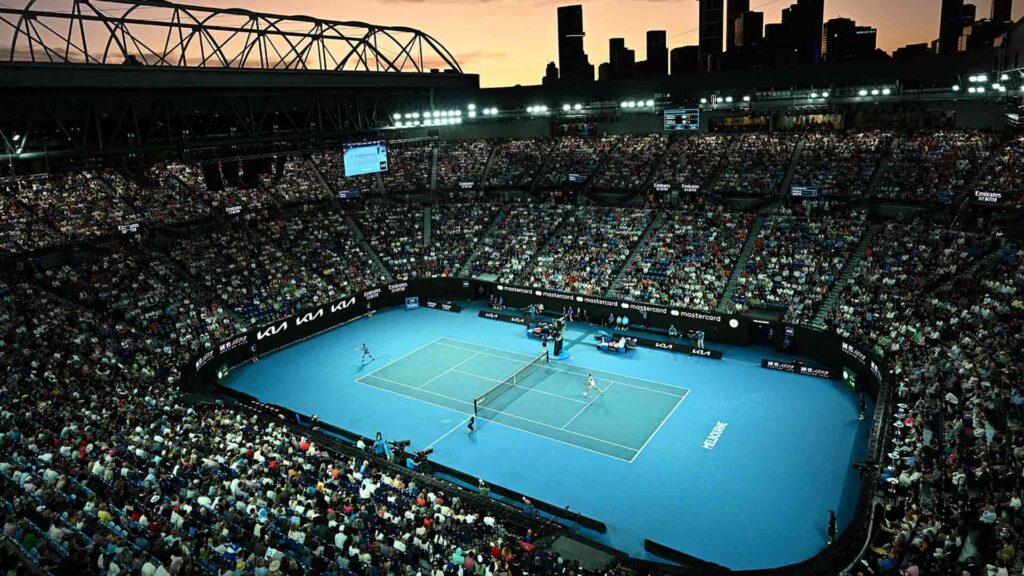
I didn’t grow up a tennis fan. It was the sport that happened on TV in the background at my grandparents’ house, vaguely prestigious, vaguely understood. And then one summer, for reasons I can no longer fully reconstruct, I sat down and actually watched a Grand Slam final from beginning to end. Something happened in those three or four hours that I wasn’t entirely prepared for.
There’s a quality of attention that a Grand Slam match demands — and rewards — that’s different from most other sport. The slowness of it. The tactical chess beneath the athletic spectacle. The way momentum shifts not in seconds but in sets. By the end, I understood why people organise their summers around Wimbledon and their January around the Australian Open.
What Makes a Grand Slam Different From Any Other Tournament
Tennis has tournaments every week, fifty weeks a year. But there are only four Grand Slams — the Australian Open, Roland Garros, Wimbledon, and the US Open — and they occupy an entirely different register. The prize money is higher, yes, and the ranking points are greater. But that’s not really why they matter.
They matter because of what they require. Best of five sets for the men. Matches that can last five or six hours. The mental endurance required to maintain focus and tactical clarity across that kind of duration is genuinely remarkable — arguably as much a psychological feat as a physical one. Dr. Mark Bawden, performance psychologist who has worked with elite athletes, describes Grand Slam tennis as one of the most comprehensive tests of psychological resilience in professional sport.
The Psychological Drama Beneath the Athletics
What draws people to Grand Slams — even people who don’t consider themselves tennis fans — is the psychological drama. The way a player can be a set and a break down and then, somehow, find something. The way a match turns. The body language of someone who’s just won the first set against the player who was expected to win. There’s a human story unfolding across those hours that transcends the sport.
Researchers studying elite sport psychology note that Grand Slam tennis is one of the most visible arenas for studying pressure performance — because everything happens slowly enough to watch in real time. You can see the player bouncing the ball seventeen times before a crucial serve. You can watch them walk to the towel, breathe, reset. The mental game is unusually visible.
Why Watching It Together Makes It Better
There’s a reason Grand Slams are such reliable social occasions — the Wimbledon party, the Australian Open all-nighter, the Pimm’s and strawberries tradition. Shared sporting experiences have been consistently documented as one of the most reliable generators of social bonding. The shared tension, the collective gasps, the arguments about who should have won — these are genuinely connecting experiences.
Research from Oxford University’s Professor Robin Dunbar — whose work on social bonding is among the most cited in the field — has found that shared risk-taking and shared emotional peaks (which spectator sport reliably provides) activate bonding mechanisms in ways that ordinary social interactions don’t. Watching a tight Grand Slam final with people you care about is, neurologically speaking, a bonding experience.
This is why investing in shared experiences — whether sporting events, annual traditions, or planned gatherings — is worth the effort. Maintaining friendships through busy seasons often comes down to finding anchoring occasions that give connection a structure it wouldn’t otherwise have. A Grand Slam is an excellent candidate. So is planning your annual friends’ gathering far enough in advance that it actually happens.
The Greatest Players and What They Teach Us
One of the enduring pleasures of following Grand Slams over years is watching the arc of a player’s career unfold across the majors. The early victories. The heartbreaking near-misses. The comebacks from injury that reframe what’s possible. The graceful acknowledgement of a rival’s extraordinary ability.
What the greatest Grand Slam champions consistently demonstrate — across very different personalities and playing styles — is a capacity for resilience that’s genuinely instructive beyond sport. The ability to lose a set, stay mentally present, and find a way back. The refusal to catastrophise a bad game. The patience to trust the process when the scoreboard is against you. These are not just sporting qualities — they’re life skills. Understanding what happens when you slow down under pressure rather than panicking is something elite players demonstrate visibly every time they walk to the towel.
Frequently Asked Questions
What is a Grand Slam in tennis?
A Grand Slam refers to any of the four major tennis tournaments: the Australian Open (January, Melbourne), Roland Garros (May-June, Paris), Wimbledon (June-July, London), and the US Open (August-September, New York). Winning all four in a single calendar year is also called a “Grand Slam” and has been achieved only a handful of times in the sport’s history.
Why are Grand Slams played on different surfaces?
Each Grand Slam is played on a different surface: Australian Open and US Open on hard courts, Roland Garros on clay, and Wimbledon on grass. The different surfaces produce fundamentally different styles of play — clay rewards baseline endurance, grass rewards serve-and-volley aggression, and hard courts sit somewhere between the two. Players who can win on all three surfaces are considered the most complete in the game.
How long does a Grand Slam last?
Each Grand Slam runs for approximately two weeks. The early rounds take place in the first week, with the quarter-finals, semi-finals, and finals spread across the second week. Individual matches can last from under an hour for a one-sided contest to over five hours in an extended five-set battle — one of the features that makes Grand Slam tennis unlike almost any other sport in its capacity for sustained drama.
How to Get Into Grand Slam Tennis
If this has convinced you to give Grand Slam tennis more of your attention, here’s a practical starting point. Pick one tournament and follow it through from the first round. You don’t need to watch every match — follow one or two players whose story interests you and track their progress through the draw. The narrative that builds across two weeks, following someone from their opening round to potentially the final, is what makes Grand Slam viewing genuinely compelling.
Wimbledon is often the easiest entry point for UK viewers — accessible on BBC, free to watch, and steeped in enough cultural familiarity to be legible even without deep tennis knowledge. The Australian Open, despite the time difference, has developed a devoted following because the night sessions create a dramatic late-evening viewing experience.
And if you can watch with people you care about — building those shared rituals with friends that anchor connection across the year — so much the better. The conversations that happen around a close match, the shared anxiety and collective celebration, are genuinely among the more joyful forms of connection available to us. These are the moments that happiness is built from — small, specific, and shared.
Further Reading & Sources

Rubie Le’Faine is the founder of Rubie Rubie and a writer specialising in emotional well-being, self-identity, and the psychology of modern relationships. She holds a Level 3 Certificate in Counselling Skills and has spent over eight years studying attachment theory, cognitive behavioural principles, and human development — first through formal study, then through lived experience that no course can replicate. After navigating a significant relationship breakdown, an identity rebuild, and the complex terrain of rediscovering herself in her 30s, Rubie began writing to make sense of what she had learned and to offer honest, human guidance to others going through the same. She founded Rubie Rubie in 2022 as a space for women seeking real answers, not platitudes. Based in Surrey, UK, her writing is grounded in research, shaped by experience, and centred entirely on the reader’s genuine wellbeing.