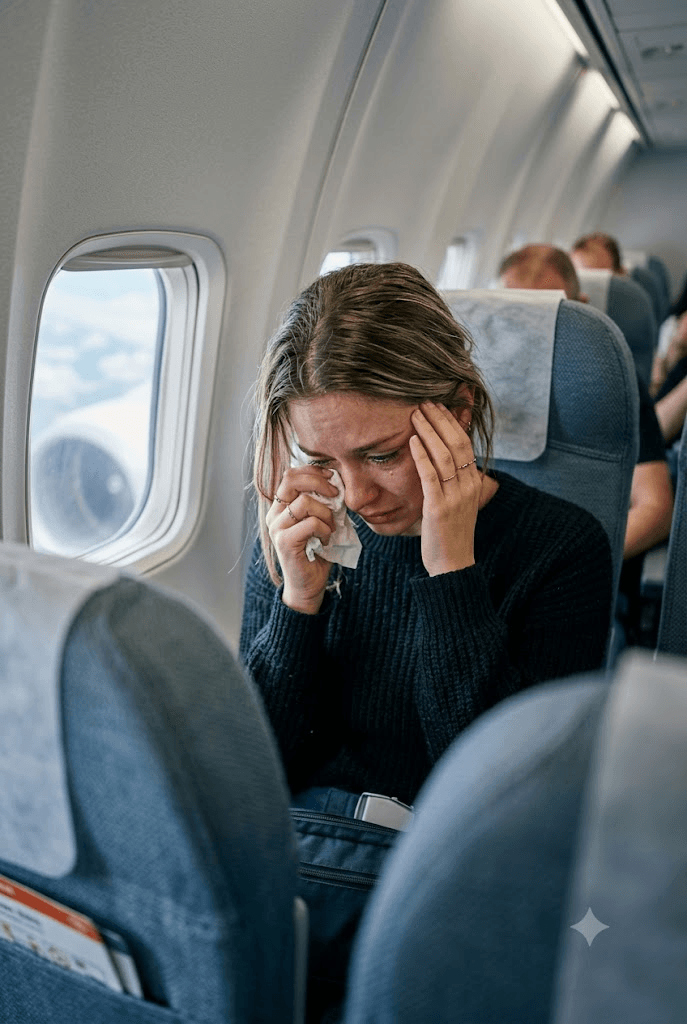
I’ve never particularly thought of myself as someone who struggles with fear. I’m fairly decisive, I take reasonable risks, I’ve built a career and a life that required some courage at various points. And yet when I look honestly at the version of myself from my early twenties — navigating a new city, uncertain relationships, an unstable financial situation, a job that constantly made me feel inadequate — I can see something underneath the competence that I didn’t have language for at the time. A low-level, pervasive sense that things could collapse at any moment, and that if they did, I wouldn’t be okay.
Emotional resilience — the capacity to navigate difficulty without being permanently undone by it — is something I had to build. It wasn’t given to me, and it didn’t arrive automatically with age. Here’s what I’ve learned about building it deliberately, particularly as a woman navigating the specific pressures that come with being a woman in the world.
What Emotional Resilience Actually Is
Resilience is one of those words that’s been used so much it’s in danger of losing its meaning. In popular usage it tends to get conflated with toughness — the ability to suppress emotion and push through. But that’s not what the research describes. Psychological resilience, as defined by Dr. Ann Masten at the University of Minnesota, who has studied it for decades, is the capacity for positive adaptation within the context of significant adversity. It’s not about not feeling the adversity — it’s about being able to move through it without permanent damage to your functioning or your sense of self.
This distinction matters enormously for women, who are often praised for their ability to endure rather than their ability to genuinely recover. Endurance and resilience are not the same thing. Endurance is pushing through. Resilience is processing, adapting, and continuing to grow even through and after difficulty.
The Foundations of Emotional Resilience
Research by the American Psychological Association identifies several consistent predictors of resilience across populations. The most powerful is the quality of your social connections — specifically, having at least one relationship in which you feel genuinely known and supported. This doesn’t require a wide social network; it requires depth. One trusted person who will be honest with you and show up for you is more protective than fifty acquaintances.
Self-efficacy — the belief that your actions make a difference, that you have some agency over your life — is another core component. This is built through experience: doing difficult things and discovering that you can handle them. Which is why resilience tends to grow through difficulty rather than in the absence of it. You can’t build it in calm water.
The capacity to regulate your own emotional states — to feel difficult emotions without being overwhelmed by them, and to return to equilibrium after stress — is the third pillar. This is developed through a combination of self-awareness, physical regulation (sleep, exercise, breathing practices), and the experience of having navigated difficulty before.
The Specific Pressures Women Navigate
Women face a set of specific stressors that research has consistently documented: higher rates of anxiety and depression than men (partially attributable to hormonal differences, partially to the social and economic stressors women disproportionately face); a persistent gender pay gap that affects financial resilience; the disproportionate burden of emotional labour in families and relationships; and the particular weight of navigating workplaces and public spaces in a female body, with all the safety considerations and subtle (and not-so-subtle) discrimination that entails.
Understanding these stressors as structural rather than personal is itself a form of resilience. When you stop explaining your exhaustion as individual weakness and start seeing it as a rational response to real and disproportionate pressure, you can address it with appropriate tools rather than simply trying harder.
Practical Ways to Build Your Resilience
The most evidence-based approaches to building emotional resilience include the following. Cultivating close, honest relationships — making the effort to maintain the friendships and family connections that nourish you, and being willing to be genuinely vulnerable in them. Regular physical exercise, which has one of the largest effect sizes of any intervention for both anxiety and depression, and which builds the physical regulatory capacity that underpins emotional regulation. Developing a reflective practice — journalling, therapy, meditation, or simply the habit of asking yourself how you’re actually doing and giving an honest answer.
Building financial resilience is also, and not incidentally, a core component of overall resilience. Financial precarity is one of the most reliable triggers of anxiety and one of the most significant limiters of women’s freedom. Understanding your finances, building a buffer, and working towards financial independence protects your ability to make choices — including the choice to leave situations that aren’t serving you. For more on this, this piece on financial independence is worth reading alongside this one.
And throughout all of this — through the building and the setbacks and the slow accumulation of genuine capability — holding onto your sense of self-worth is the foundation. If you’ve been feeling like the challenges have been eroding that sense of self, this piece on embracing your true self-worth offers a grounding reset. And understanding the relationship between resilience and the anxiety and depression that can arise when it’s tested is addressed in this honest exploration.
From Fear to Freedom: The Long Game
Emotional resilience is not built in a weekend workshop or a single transformative experience. It’s built through years of small choices — the choice to process rather than suppress, to ask for support rather than white-knuckle through, to keep showing up for the relationships and practices that nourish you even when life is demanding something else. The payoff is a kind of freedom: not freedom from difficulty, but freedom within it. The knowledge — body-deep, not just intellectual — that you can handle what comes, that you’ve handled hard things before, and that you will again.
Frequently Asked Questions
Can emotional resilience be built if you’ve had a difficult upbringing?
Yes — and this is one of the most encouraging findings in resilience research. While early adversity does increase risk for certain difficulties, it does not determine outcomes. Research consistently shows that secure attachment relationships formed in adulthood — with romantic partners, close friends, or therapists — can provide many of the regulatory and relational capacities that were not built in childhood. This is sometimes called “earned security,” and it’s genuinely achievable. Therapy, particularly attachment-focused approaches, can be profoundly helpful in this process.
What’s the difference between resilience and just pushing through?
Pushing through means continuing to function despite difficulty without fully processing it — which works in the short term and accumulates cost in the long term. Resilience involves actually processing the difficulty — feeling it, understanding it, and integrating it — which is harder in the short term and far less costly over time. People who “push through” without processing often find that the accumulated material eventually surfaces in burnout, physical illness, relationship difficulty, or mental health crises. Resilience, genuinely built, tends to produce increasing capacity over time rather than increasing fragility.
How do I know if I need therapy to build resilience?
You don’t need to be in crisis to benefit from therapy. Many people find it most useful precisely in the non-crisis periods — when there’s enough headspace to actually explore patterns, build self-awareness, and develop new capacities. If you’re noticing that you respond to difficulty with the same patterns repeatedly, that your emotional responses often feel disproportionate to situations, or that you’re managing to function but without much genuine joy or connection, these are all reasonable grounds to seek professional support. The fact that others “have it worse” is not a disqualifying factor.
Further Reading & Sources

Rubie Le’Faine is the founder of Rubie Rubie and a writer specialising in emotional well-being, self-identity, and the psychology of modern relationships. She holds a Level 3 Certificate in Counselling Skills and has spent over eight years studying attachment theory, cognitive behavioural principles, and human development — first through formal study, then through lived experience that no course can replicate. After navigating a significant relationship breakdown, an identity rebuild, and the complex terrain of rediscovering herself in her 30s, Rubie began writing to make sense of what she had learned and to offer honest, human guidance to others going through the same. She founded Rubie Rubie in 2022 as a space for women seeking real answers, not platitudes. Based in Surrey, UK, her writing is grounded in research, shaped by experience, and centred entirely on the reader’s genuine wellbeing.