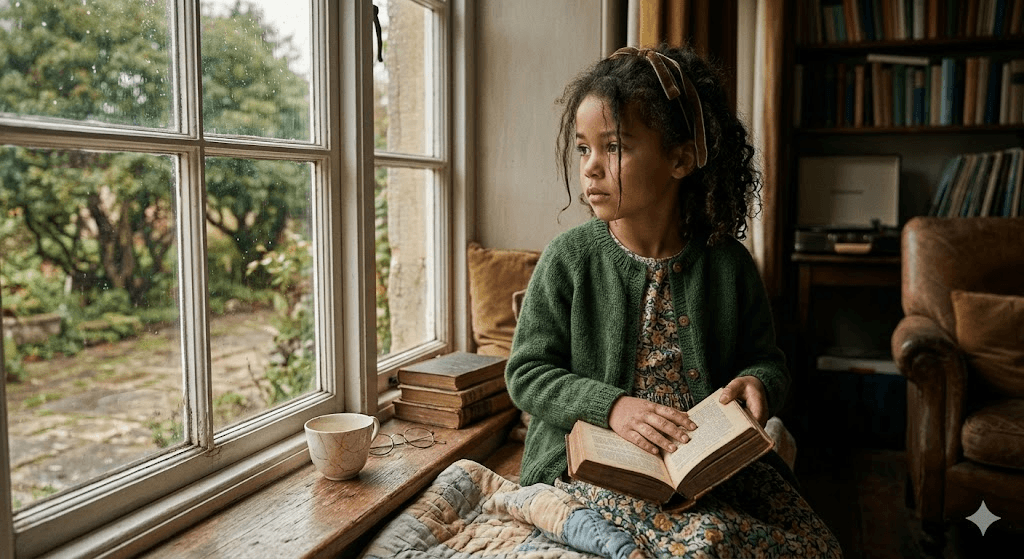
Have you ever looked at your child and felt, for just a moment, that you were in the presence of someone much wiser than their years? Maybe they said something that stopped you in your tracks — a quiet observation about life, loss, or love that no five-year-old should be able to articulate. Or perhaps they simply seem more comfortable with solitude, with deep conversation, or with the weight of the world than most adults you know.
If this resonates, you may be raising what many call an old soul — a child whose inner life seems to run deeper and quieter than those around them. This is not a diagnosis or a label, but rather a description of a particular way of moving through the world. Old soul children are often gentle, perceptive, and deeply feeling. And while parenting them can be enormously rewarding, it can also be disorienting if you don’t know what you’re looking at.
Here are seven signs your child has an old soul — and what it means for how you support them.
1. They Prefer Deep Conversation Over Small Talk
Most children are happy chatting about cartoons, their favourite snacks, or what happened at school. An old soul child, however, tends to gravitate toward conversations that matter — questions about why people die, whether animals have feelings, what happens when you love someone and they leave. They don’t do this to be dramatic; they’re simply wired for depth.
You may notice that they disengage during idle chatter but come alive when someone asks them a real question. They want to be taken seriously, not just entertained. If your child is the one asking “but why do people go to war?” at the dinner table, you probably know what I mean.
2. They Feel Things Very Deeply
Old soul children are often highly sensitive — not in a fragile way, but in a receptive way. They pick up on the emotional undercurrents in a room before anyone has said a word. They sense when a parent is stressed, when a friend is pretending to be okay, or when something in their environment has shifted.
This emotional depth is a gift, but it can also be overwhelming. Understanding emotional intuition as a parent can help you support them. for a child who hasn’t yet developed the tools to process what they’re absorbing. They may cry at the news, feel distressed about injustice, or become deeply unsettled when they witness cruelty — even in fiction. Rather than trying to toughen them up, the wisest approach is to help them name and honour what they feel, while teaching them gentle boundaries so they don’t carry the weight of everyone else’s pain.
3. They Are Drawn to Solitude
While other children might beg for playdates and bounce off the walls in groups, your old soul child might happily spend an afternoon alone — drawing, reading, playing imaginatively, or simply thinking. This is not antisocial behaviour. It’s restoration.
Old soul children often find large groups draining and prefer the company of one or two trusted people over a crowd. They may struggle in noisy, chaotic environments and thrive when given space and quiet. If your child consistently comes home from social events exhausted and needs time alone to decompress, this is a significant signal. Honour it. Their need for solitude is as genuine as anyone else’s need for connection.
4. They Seem Wise Beyond Their Years
Perhaps the most defining quality of an old soul is that their wisdom doesn’t seem proportional to their age or experience. They say things that leave adults quiet. They offer comfort in ways that feel almost ancient. They understand nuance — that people can be both good and flawed, that situations are rarely simple, that sometimes there are no easy answers.
A six-year-old who tells their grieving grandmother, “It’s okay to be sad. She was really yours,” is speaking from somewhere beyond textbook emotional development. These moments are not coincidences. They reflect a child who is paying extraordinary attention to the human experience and has a natural capacity for compassion and insight.
5. They Don’t Fit Neatly Into Peer Groups
Old soul children often feel different from their peers — and their peers can sense it too. This doesn’t mean they’re disliked, but they may struggle to find their tribe. The games other children play might feel hollow to them. The social hierarchies of the playground may baffle or bore them. They often connect better with adults, older children, or with one deeply trusted friend than with a large group of same-age peers.
This can be a source of real loneliness, particularly in the early school years. As a parent, one of the most helpful things you can do is validate that it’s okay to be different, actively help them find communities where their depth is appreciated (book clubs, nature groups, creative classes), and remind them that growing up feeling slightly out of step often produces some of the most extraordinary adults.
6. They Have a Strong Sense of Purpose or Justice
Many old soul children arrive with what feels like a built-in moral compass. They care intensely about fairness. They notice when someone is being left out. They feel genuine distress at injustice — in their school, in the news, in the world at large. They may be drawn to causes, to helping others, or to asking big questions about how things should be.
This sense of purpose can manifest early. They may tell you they want to be a vet, a teacher, or someone who helps people who are sad. Or they might be more abstract about it — a quiet but unshakeable sense that they are here for something, that their life has meaning, even if they can’t yet say what that meaning is.
Nurture this instinct. Don’t dismiss it as childish idealism. Old soul children who are encouraged in their sense of purpose often grow into adults of tremendous integrity and impact.
7. They Are Comfortable With Concepts Adults Find Difficult
Death, impermanence, the passage of time, spiritual questions — these are subjects many adults avoid. Old soul children often move toward them with a kind of easy familiarity. They may talk about death without distress, ask where people go when they die with genuine curiosity rather than fear, or express a comfort with the unknown that surprises the adults around them.
They may also display an unusual connection to nature, to animals, or to what many traditions would call the sacred. They notice the moon. They feel something when they stand in old forests. They are moved by music in ways that seem to reach beyond their years. These are not signs of strangeness — they are signs of a child who is deeply, quietly awake to the world.
How to Parent a Child Who Has an Old Soul
Raising an old soul child is both a privilege and a responsibility. They need adults who take them seriously, who don’t talk down to them, and who understand that their quietness is not emptiness but fullness. Here are a few principles worth holding onto:
- Honour their solitude. Don’t force socialisation when they need to recharge. Alone time is not loneliness for these children — it is nourishment.
- Take their questions seriously. When they ask hard questions, resist the urge to deflect. Sit with them in the not-knowing. The conversation matters more than the answer.
- Find their people. Seek out communities — classes, groups, activities — where depth and sensitivity are valued rather than treated as oddities.
- Validate their sensitivity. Don’t ask them to toughen up or stop feeling so much. Help them learn to process their emotions, not suppress them.
- Let them move slowly. Old soul children often resist being rushed. They need time to think, to transition, to absorb. Build that time in wherever you can.
Most of all, remember that you don’t need to fix or change these children. They are not broken, not behind, not too much. They are simply wired for depth in a world that often rewards noise. Your job is not to make them smaller — it’s to help them learn to carry their extraordinary inner lives with grace.
For further reading on nurturing sensitive, deep-feeling children, Psychology Today’s guide on old soul children is an excellent resource.
And if you pay close attention, they will probably teach you a thing or two as well.

Gracie Webb is a writer and researcher with a first-class degree in Psychology and over seven years of experience studying behavioural change, self-development, and the science of decision-making. She worked for four years as a research assistant in a cognitive behavioural therapy clinical setting, where she observed first-hand the gap between what people know they should do and what they actually do — a gap that sits at the centre of nearly all her writing. Gracie’s personal journey through a toxic long-term relationship, the slow process of rebuilding her self-worth, and the year she spent in therapy gave her both the intellectual framework and the personal authority to write about growth with honesty. Her work is rigorous, compassionate, and consistently aimed at the reader who is genuinely trying to change.