A wine and cheese night with your closest friends is one of the most underrated forms of genuine self-care and connection. Simple in concept, endlessly elevated in execution, it creates exactly the kind of relaxed, unhurried space that busy modern life rarely affords: good food, interesting flavours, and uninterrupted time with people who matter. Whether you are planning your first gathering or your fiftieth, these sommelier-approved tips will take your evening from pleasant to genuinely memorable.
Why Wine and Cheese Nights Are More Than Just a Gathering
There is a reason why wine and cheese gatherings appear across almost every culture that produces either: the pairing is a natural invitation to slow down, pay attention, and be present. The ritual of opening a bottle, the sensory engagement of tasting, the conversation that flows easily around a shared experience — these things create conditions for genuine connection rather than distracted socialising.
For many women, a regular girls gathering is a vital social infrastructure that protects mental health, maintains important friendships, and provides a space outside of roles — partner, mother, employee — to simply be yourself. Investing thoughtfulness in that gathering is an investment in all of those things. Exploring the types of friendships every woman genuinely needs can help you appreciate why these gatherings deserve more than a quick afterthought.
Tip 1: Build Around a Theme
Rather than assembling an eclectic mix of whatever is available, build your evening around a simple theme — a specific wine region, a single grape variety expressed across different producers, or a cheese category from one tradition. This creates a cohesive tasting experience and gives the conversation a natural anchor: you are not just drinking wine together, you are exploring something together. Theme ideas include a tour of Burgundy (Pinot Noir and Chardonnay), a comparison of New World vs Old World Sauvignon Blanc, or a celebration of soft, washed-rind French cheeses.
Themed evenings also make the host’s preparation easier. Rather than trying to balance wildly different flavours, you are working within a coherent flavour family. And the theme gives guests something to look up in advance if they want to come prepared — creating shared engagement that extends the evening’s pleasure.
Tip 2: Understand the Basic Pairing Logic
Sommeliers follow a few reliable pairing principles that even casual wine drinkers can apply. The most fundamental: match weight with weight. A light, delicate white like Chablis pairs beautifully with fresh, young cheeses like fresh chèvre or burrata. A fuller, oaked white like white Burgundy holds up beautifully to richer, creamier cheeses like Brie or Camembert. Medium-bodied reds pair well with aged hard cheeses like Comté or Gruyère. Bold reds (Cabernet Sauvignon, Barolo) are at their best with firm, aged cheeses like aged Manchego, Pecorino, or extra-mature Cheddar.
The exception worth noting: big tannic reds and soft, creamy cheeses are a notoriously difficult pairing — the tannins clash with the fat in a way that makes both taste worse. Stick to whites or lighter-style reds when your cheese board is dominated by soft varieties.
Tip 3: Temperature Is Everything
Both wine and cheese are frequently served at the wrong temperature. Wine is almost always served too cold (whites) or too warm (reds), while cheese is almost always served too cold (straight from the refrigerator). A Chardonnay served at refrigerator temperature loses most of its complexity. A Pinot Noir served at true room temperature in a warm room tastes flat and overly alcoholic. The ideal serving temperature is around 10–12°C for full whites, 7–9°C for lighter whites, and 14–16°C for reds — achievable by taking reds out of storage an hour or so before service rather than chilling or warming dramatically.
Cheese should be removed from the refrigerator at least 30–60 minutes before serving. Cold suppresses flavour across the board. A Brie that tastes chalky and bland cold will reveal extraordinary complexity — buttery, mushroomy, and rich — at room temperature. This single change will transform the quality of your cheese board more than any other.
Tip 4: Build a Board With Contrast
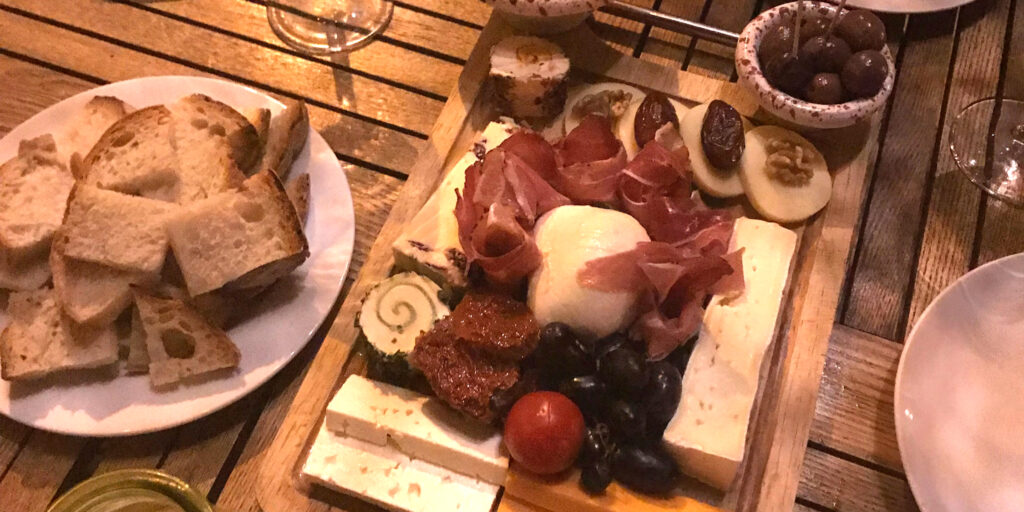
A thoughtfully composed cheese board creates its own tasting journey through textural and flavour contrast. Aim for variety across four categories: fresh (chèvre, ricotta, burrata), soft-ripened (Brie, Camembert, Taleggio), semi-hard (Comté, Gouda, Manchego), and hard/aged (Parmesan, aged Cheddar, Pecorino). Adding blue cheese — Roquefort, Gorgonzola, or Stilton — introduces a fifth flavour dimension that the wines can play against.
Around the cheeses, build accompaniments that complement rather than compete: honey (wonderful with blue cheese and with aged hard cheeses), chutney (apple or onion works well with sharp aged Cheddar), fresh and dried fruit (figs, grapes, apricots), toasted nuts, and a variety of crackers and bread. The extras are not filler — they are flavour bridges that expand pairing possibilities significantly.
Tip 5: Add One Unexpected Bottle
Every wine gathering benefits from at least one genuinely unexpected bottle — something outside the group’s comfort zone that invites curiosity rather than simply satisfying a familiar preference. A natural wine with slightly funky, earthy notes. An orange wine that behaves like a red in a white’s body. A Jura Savagnin with its extraordinary oxidative complexity. A serious sparkling wine from a region no one has tried. The unexpected bottle becomes a shared reference point, a conversation piece, and often the most remembered wine of the evening.
These kinds of shared novel experiences are precisely what deepen friendship. Novelty, attention, and presence create the conditions for real connection — which is ultimately what a girls gathering is for. These are the kinds of evenings that sustain the friendships described in the types of friends every woman needs in her life.
Tip 6: Create the Right Environment
The physical environment significantly shapes how relaxed, present, and open people feel. Soft lighting — candles, dimmed lamps — is more conducive to genuine conversation than overhead lights. Comfortable seating arranged to encourage togetherness rather than parallel sitting. Background music at a volume that creates atmosphere without competing with conversation — instrumental works particularly well. Small touches of beauty — fresh flowers, cloth napkins, interesting glasses — communicate care and set a tone of celebration without requiring elaborate preparation.
Tip 7: Slow Down and Pay Attention
The finest sommelier insight of all is deceptively simple: slow down and actually pay attention to what you are tasting. Take a moment before drinking to look at the wine’s colour, swirl it, and smell it before the first sip. Let cheese sit on the tongue for a moment before chewing. Notice what changes as the wine warms slightly in the glass, or as the cheese reaches the back of the mouth. This is not pretentiousness — it is the act of being genuinely present, which is its own form of pleasure and restoration. And that is exactly what genuine self-care actually looks like: not a chore, but a practice of savouring what is good.
Frequently Asked Questions
How much wine and cheese do I need per person?
For a dedicated wine and cheese evening (2–3 hours, pre-dinner or as the main event), plan on approximately 75–100ml of each wine per person per wine if you are tasting multiple bottles, or one standard bottle (750ml) between three to four people if serving a single wine. For cheese, 100–150g of cheese per person is typical for a substantial board, with slightly less if you are serving other food alongside.
What are good choices for guests who do not drink alcohol?
Non-alcoholic wines have improved dramatically in quality over recent years — look for premium brands that use genuine wine grapes and vacuum distillation or spinning cone technology rather than simple grape juice. Sparkling water with fruit serves beautifully alongside cheese. A non-alcoholic sparkling option gives non-drinkers a similarly ceremonial glass to raise, which matters for the sense of shared celebration.
How do I store leftover cheese properly?
Cheese should be wrapped individually in wax paper (not cling film, which suffocates the cheese and accelerates deterioration) and stored in the least cold part of your refrigerator — the cheese or salad drawer. Most hard and semi-hard cheeses will keep well for 1–2 weeks after opening this way. Soft cheeses are best consumed within a few days. Bring each piece back to room temperature before eating — the flavour difference is significant.
Sources & further reading: Wine Spectator: Wine and Food Pairing Basics | Psychology Today: The Importance of Social Gatherings | Mental Health Foundation: Friendship and Wellbeing.

Cassandra Simpson is a wellbeing and relationship writer with a BSc in Psychology and five years of experience working in community mental health support. She writes about love, friendship, boundaries, and the emotional work of belonging — drawing on both academic grounding and the hard-won perspective that comes from navigating her own relationship patterns, friendships, and personal growth in real time. Cassandra trained as a peer support facilitator and has spent years exploring attachment theory, interpersonal dynamics, and the psychology of connection. Her writing is shaped by a deep belief that most relationship struggles come not from failure, but from the absence of honest, accessible information about how human connection actually works.